
Eight to ten is the age when reading can grow into a lifelong habit or begin to fade. Children can read fluently, they have stronger tastes, and they also have more homework, more activities and more screens competing for their attention. Scholastic's Kids & Family Reading Report notes that reading for fun and positive feelings about reading decline as children grow, with declines marked by age 9.
That makes this the best time to put the right book in their hands. The books below range from classic to modern, and from gentle to funny.
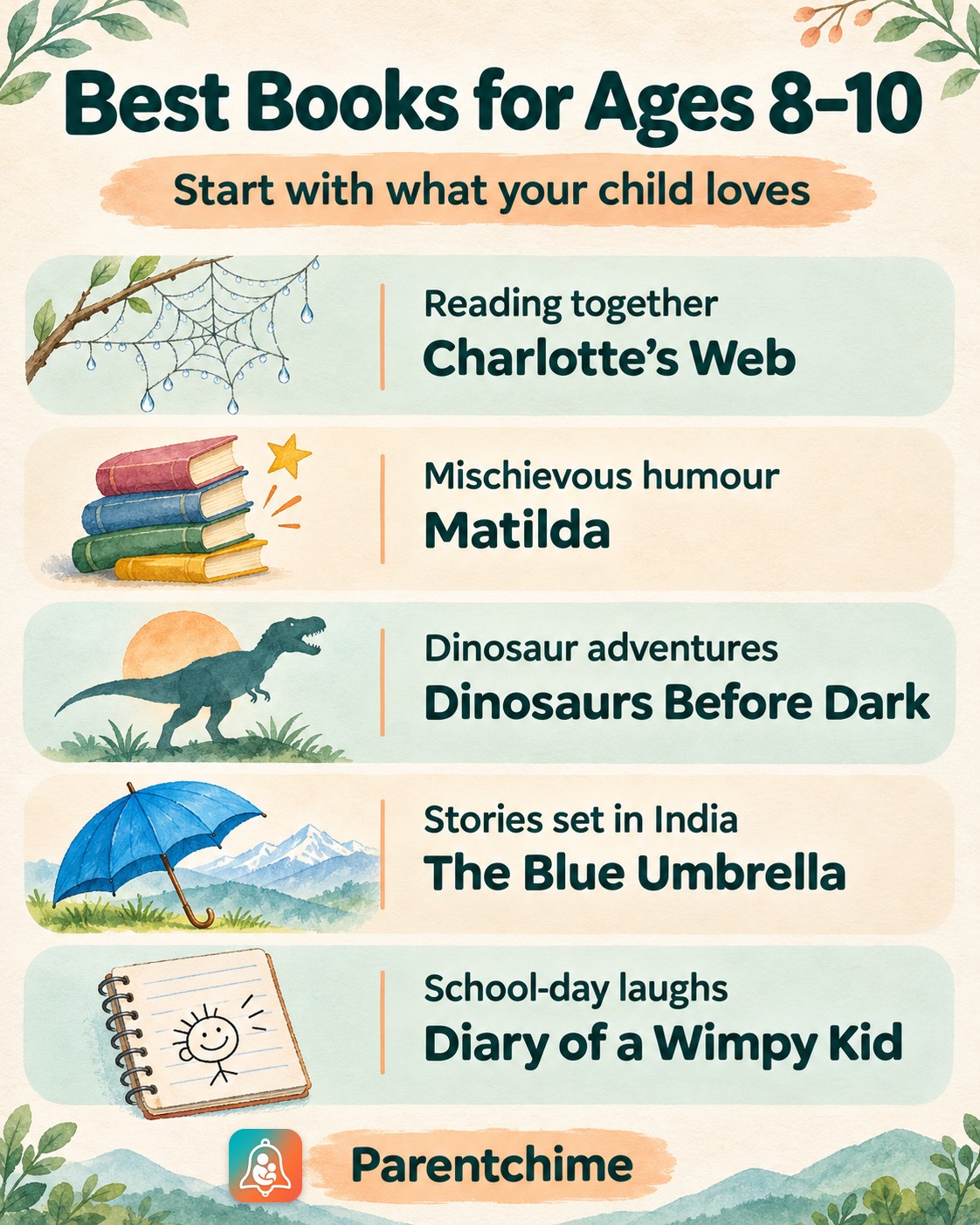
Ratings and prices at a glance
| Book | Author | Rating | No. of ratings | Price | Why parents love it |
|---|---|---|---|---|---|
| Charlotte's Web | E. B. White | 4.6 | 32,583 | from ₹298 | A classic about friendship, read one short chapter at a time |
| Matilda | Roald Dahl, illustrated by Quentin Blake | 4.6 | 23,559 | ₹324 | Funny, a little wicked, and a celebration of reading |
| Magic Tree House #1: Dinosaurs Before Dark | Mary Pope Osborne | 4.6 | 7,328 | ₹205 | Short chapters and a first series to grow into |
| The Blue Umbrella | Ruskin Bond | 4.5 | 17,049 | ₹159 | A short, gentle story set in the Himalayas |
| Diary of a Wimpy Kid (Book 1) | Jeff Kinney | 4.6 | 31,322 | ₹283 | Cartoons and short entries that are easy to dip into |
| Charlie and the Chocolate Factory | Roald Dahl | 4.6 | 22,402 | ₹328 | Chocolate, imagination and a gentle lesson about greed |
| Famous Five #1: Five on a Treasure Island | Enid Blyton | 4.6 | 4,363 | ₹147 | Classic adventure with a first series to grow into |
| Goosebumps #7: Night of the Living Dummy | R. L. Stine | 4.4 | 3,479 | ₹209 | Spooky, page-turning fun for children who like a shiver |
| Dog Man (Book 1) | Dav Pilkey | 4.6 | 29,440 | from ₹620 | Silly comic fun that hooks reluctant readers |
| Mahabharata | Kamala Chandrakant, Amar Chitra Katha | 4.4 | 1,809 | ₹99 | A first look at the great epic, in comic form |
| The Lion, the Witch and the Wardrobe | C. S. Lewis | 4.8 | 1,410 | ₹499 | A wardrobe door into a world made for reading together |
| The Phantom Tollbooth | Norton Juster, illustrated by Jules Feiffer | 4.7 | 10,124 | ₹573 | Puns, numbers and an adventure for curious minds |
| Harry Potter and the Philosopher's Stone | J. K. Rowling | 4.7 | 146,632 | ₹439 | Read it aloud now, read it alone later |
| The Wild Robot | Peter Brown | 4.7 | 17,574 | from ₹272 | A robot, an island and a lot of heart |
| Because of Winn-Dixie | Kate DiCamillo | 4.7 | 14,428 | ₹459 | A stray dog and a lonely girl in a short, warm story |
| Grandma's Bag of Stories | Sudha Murty | 4.6 | 21,604 | ₹193 | Short Indian tales, one sitting each |
| Encyclopedia Brown, Boy Detective | Donald J. Sobol | 4.6 | 2,275 | ₹627 | Ten short mysteries to solve in every book |
| Horrible Histories: Ruthless Romans | Terry Deary, illustrated by Martin Brown | 4.6 | 611 | ₹300 | History with the gory, funny bits left in |
Ratings and prices are from Amazon India on 13 November 2026 (24 November 2026 for Charlie and the Chocolate Factory, Famous Five and Goosebumps) and may have changed since. All are paperbacks. Charlotte's Web is the Puffin 70th Anniversary Edition, which had no direct Amazon listing price that day, so the price shown is the lowest paperback price offered. The Blue Umbrella is the Illustrated Edition. Charlie and the Chocolate Factory is the 2022 Puffin paperback. Famous Five is book 1, Five on a Treasure Island, and Goosebumps is #7, Night of the Living Dummy. Rating counts can include other editions of the same book.
Books 9 to 18 were checked on Amazon India on 26 November 2026. Dog Man lists a hardcover price on its main page, so the price shown is the lowest paperback price offered. The Wild Robot price is also the lowest paperback price offered. Because of Winn-Dixie shows the price of the newer paperback edition. The Mahabharata is a single 32-page Amar Chitra Katha comic. The Lion, the Witch and the Wardrobe is the HarperCollins paperback, The Phantom Tollbooth is the Yearling paperback, Harry Potter is the Bloomsbury paperback and Ruthless Romans is the Scholastic UK paperback. Prices and ratings may have changed since.
How to support an 8 to 10 year old reader
Let them choose. A child who picked the book is far more likely to want to finish it.
Protect the time. Twenty minutes before bed, a weekend morning with tea and a book, or a family reading hour with everyone holding something different.
Welcome series. A child who loves book one will happily read book two, which builds stamina without any pushing.
Read aloud together. A chapter a night of a longer book keeps the shared moment alive.
The books
1. Charlotte's Web by E. B. White
Best for families who enjoy reading aloud together.
Wilbur the pig is saved from the butcher when a clever spider named Charlotte weaves words into her web to praise him. It is a classic about loyalty, courage and loss, and the chapters are short enough to read one at a time. It also tends to spark real conversations about friendship and the passing of time.
Try this: after each chapter, ask your child what word they would have woven into the web.
2. Matilda by Roald Dahl, illustrated by Quentin Blake
Best for children who love mischievous humour and seeing bullies outsmarted.
Matilda is a small girl who has read widely by the age of four, with parents who do not care and a headmistress, Miss Trunchbull, who is frightening. The book is funny and a little wicked, and it makes the case that reading gives a child power. It is a favourite among children who have not yet found their own book.
Try this: ask your child which book Matilda would pick for them.
3. Magic Tree House #1: Dinosaurs Before Dark by Mary Pope Osborne
Best for dinosaur fans ready to try their first chapter-book series.
Jack and Annie find a tree house in the woods that carries them back to the time of the dinosaurs. The chapters are short, the plot moves quickly, and each book blends adventure with real history or science. There are dozens more in the series, which makes it a good first series for a child who has not yet read one.
Try this: after finishing, look up one dinosaur from the book and see what you can find out about it.
4. The Blue Umbrella by Ruskin Bond
Best for children who want a short, gentle story set in India.
Binya, a young girl in a Garhwal village in the Himalayas, trades her leopard-claw pendant for a beautiful blue umbrella and finds that it makes the people around her envious. It is a short, gentle novella about generosity, jealousy and kindness, and it is a good first Ruskin Bond.
Try this: ask your child how the story would change if the umbrella were another colour, or if Binya hadn't shared it.
5. Diary of a Wimpy Kid by Jeff Kinney
Best for children who reach for cartoons and funny school stories.
Greg Heffley records his first year of middle school in a diary full of cartoons. The drawings are part of the joke, and the short diary entries make it easy to dip in. If Greg's school-day disasters click with your child, there's a whole series to explore.
Try this: ask your child to start their own diary, with cartoons.
6. Charlie and the Chocolate Factory by Roald Dahl
Best for children who love imagination, sweets and a good comeuppance.
Charlie Bucket's family barely has enough to eat, so when he finds one of five golden tickets hidden in chocolate bars, a tour of Willy Wonka's secret factory feels like a miracle. The other four winners are a greedy boy, a spoilt girl, a gum-chewer and a TV addict, and the factory has its own ways of dealing with each. The chocolate river, the Oompa-Loompas and their silly songs make it a book children ask to hear again, and underneath the fun it makes a quiet case for kindness over greed. The 2022 Puffin edition listed here has text updated for young independent readers.
Try this: ask your child which sweet they would invent for Wonka's factory, and what it would do.
7. Famous Five #1: Five on a Treasure Island by Enid Blyton
Best for children who dream of secret maps, picnics and solving a mystery with their friends.
Julian, Dick and Anne spend their holidays with their cousin George and her dog Timmy, and soon they are off to an island with a wrecked ship, hidden treasure and some people who would very much like to find it first. The chapters are quick, the cliffhangers keep the pages turning, and there are twenty-one books in the series, so a child who enjoys the first has plenty to read next. It was written in 1942, so a few details feel old-fashioned, which can lead to good chats about how life has changed.
Try this: pack a picnic and let your child plan a treasure hunt in the garden or park.
8. Goosebumps #7: Night of the Living Dummy by R. L. Stine
Best for children who love a shiver and are happy to be a little scared.
Lindy finds a ventriloquist dummy named Slappy, and soon strange things start happening that nobody else can explain. Goosebumps books are short, fast and end on a twist, so they suit children who say they do not like reading, and with more than sixty books in the original series there is always another one waiting. The scares are spooky and quickly over, though very sensitive children may prefer to wait until they are a little older, and you can always read the first chapter together to see how your child feels.
Try this: read it in daylight, then ask your child to guess how the next Goosebumps twist might go.
More books for different kinds of children
The first eight picks mix classics and series. The ten below are for particular kinds of 8 to 10 year olds: the comic fan, the fantasy fan, the animal lover, the story lover, the young detective and the child who collects facts. They continue the numbering above, so the earlier picks keep their places.
Most of these are new to our reading lists. Two connect to other lists, and we say why in their entries. Harry Potter also appears in our list for 11 to 13 year olds, and the Mahabharata comic below leads towards the prose retelling in our list for ages 16 and above.
9. Dog Man by Dav Pilkey
Best for children who love comics, silly jokes and a hero who is part dog, part police officer.
Dog Man is a crime-fighting hound with the head of a dog and the body of a human, dreamed up by two schoolboys in the story. The pages are full of cartoons, the sentences are short, and the jokes arrive every few seconds, which is why it works so well for children who say they do not like reading. Common Sense Media rates it for age 7 and up and mentions that some parents find the potty humour and cartoon slapstick over the top. It is the first of a long series, so a child who enjoys it has plenty to read next.
Try this: ask your child to draw their own half-animal hero and invent the villain.
10. Mahabharata by Kamala Chandrakant (Amar Chitra Katha)
Best for children ready to meet India's great epic in comic form.
Amar Chitra Katha has been telling Indian stories as picture comics since 1967. This 32-page issue gives a quick, picture-led tour of the saga of the Pandavas and Kauravas, short enough to finish in one sitting. It makes a good first taste before the longer comic volumes, which tell the epic in 42 stories across three volumes. The epic includes a great war, so read the first few pages together and see how your child takes it. Our list for ages 16 and above includes C. Rajagopalachari's prose retelling, which is a natural later step.
Try this: ask your child which Pandava they would want on their team, and why.
11. The Lion, the Witch and the Wardrobe by C. S. Lewis
Best for children who dream of hidden doors, talking animals and a brave stand against a villain.
Four siblings step through a wardrobe into Narnia, a land held in endless winter by the White Witch. Edmund is lured into betraying the others, and Aslan the lion is the hope the whole land is waiting for. Common Sense Media rates it 8 and up, with some battle scenes and Christian themes, and notes that some readers find the style dated. It reads aloud well, which makes it a lovely book to share before your child tries the rest of the Narnia series alone.
Try this: ask your child what they would take into Narnia, and what they would leave behind in the wardrobe.
12. The Phantom Tollbooth by Norton Juster
Best for curious children who love wordplay, puns and number jokes.
Milo is bored with everything until a tollbooth appears in his room and carries him to the Kingdom of Wisdom, where he sets out to rescue Rhyme and Reason. The story is packed with puns and playful logic, and Jules Feiffer's drawings add to the fun. Common Sense Media rates it 8 and up and the publisher suggests 9 to 12. Some of the jokes need unpacking, so it can be a good one to start reading together.
Try this: pick a saying such as "raining cats and dogs" and act out what it would look like if it were literally true.
13. Harry Potter and the Philosopher's Stone by J. K. Rowling
Best for families who want a long, magical story to read aloud now and read again alone later.
This is the one deliberate repeat, since it also appears in our list for 11 to 13 year olds. We include it here because many children meet Harry at 8 or 9, as a read-aloud or an audiobook, and read the whole series on their own a couple of years later. Common Sense Media's age guide calls 8 a great age to begin and suggests reading aloud together. The same guide says the later books get darker and more intense, so there is no need to rush ahead.
Try this: read one chapter a night and ask your child to guess what happens next before you turn the page.
14. The Wild Robot by Peter Brown
Best for children who love animals, nature and a story with real heart.
After a cargo ship sinks, a robot named Roz wakes up alone on a wild island. To survive she has to learn from the animals, who are not at all welcoming at first. It has short chapters and an easy pace, and the story has been made into an animated film. Common Sense Media rates it 8 and up and notes moments of peril, including a bear attack early on, so sensitive readers may want a parent nearby. It is the first of three books.
Try this: ask your child what one thing a robot could learn from an animal, and what one thing an animal could learn from a robot.
15. Because of Winn-Dixie by Kate DiCamillo
Best for children who love dogs and quiet, feeling-filled stories.
Ten-year-old Opal goes to the supermarket for groceries and comes home with a stray dog she names Winn-Dixie. The dog helps her make friends, and gives her the courage to ask her father about the mother who left when she was three. It is short at 182 pages and it won a Newbery Honor. Common Sense Media rates it 9 and up. It is gentle but a little sad in places, which makes it a good book to talk about afterwards.
Try this: ask your child to list ten things about someone they love, just as Opal's father does for her.
16. Grandma's Bag of Stories by Sudha Murty
Best for children who love short stories, Indian folk tales and being read to by a grandparent.
Four cousins arrive at their grandparents' house in Shiggaon, and each evening Ajji opens her big bag of stories, full of kings and cheats, monkeys and mice, and princesses and hidden treasure. There are more than 20 illustrated stories in simple language, each short enough to read in one sitting. Amazon suggests 6 and up, so it works as a read-aloud and as a first independent read at this age. If your child enjoys it, Grandpa's Bag of Stories and Grandparents' Bag of Stories come next.
Try this: ask a grandparent to tell a story from when they were nine, then write it down together.
17. Encyclopedia Brown, Boy Detective by Donald J. Sobol
Best for children who love puzzles and solving things before the grown-up does.
Ten-year-old Leroy Brown, nicknamed Encyclopedia, solves the mysteries that baffle the grown-ups of Idaville. Each book gives readers every clue they need to crack ten cases themselves. At 96 pages it is quick to read, which suits children who are easily discouraged by long books. Common Sense Media rates the series 7 and up, and there are many more books to follow.
Try this: read each case aloud, stop before the solution, and let the whole family vote on who did it.
18. Horrible Histories: Ruthless Romans by Terry Deary
Best for children who love facts, gross details and funny history.
Horrible Histories tell the past with the gory, smelly and strange bits left in, with jokes and cartoons by Martin Brown throughout. It is easy to dip into, so it suits children who would rather read a page here and there than a whole story. The gory facts are the appeal, so look at a few pages first if your child is squeamish. Other volumes cover the Egyptians, the Greeks and many more.
Try this: ask your child to pick the most unbelievable fact and have the family guess whether it is true.
Building the habit
A child of eight to ten wants a say in what they read, a regular slot to read in, and a parent who reads too. Offer a mix of comfort reads and stretch reads, and keep a shelf of options within reach. Children also move from hearing a book to reading it alone, so keep a few read-aloud favourites on the shelf beside the books they read themselves.
Stock, format and prices vary by seller, so check the edition before you buy.
Comments
No comments yet. Be the first to share what worked for your family.